
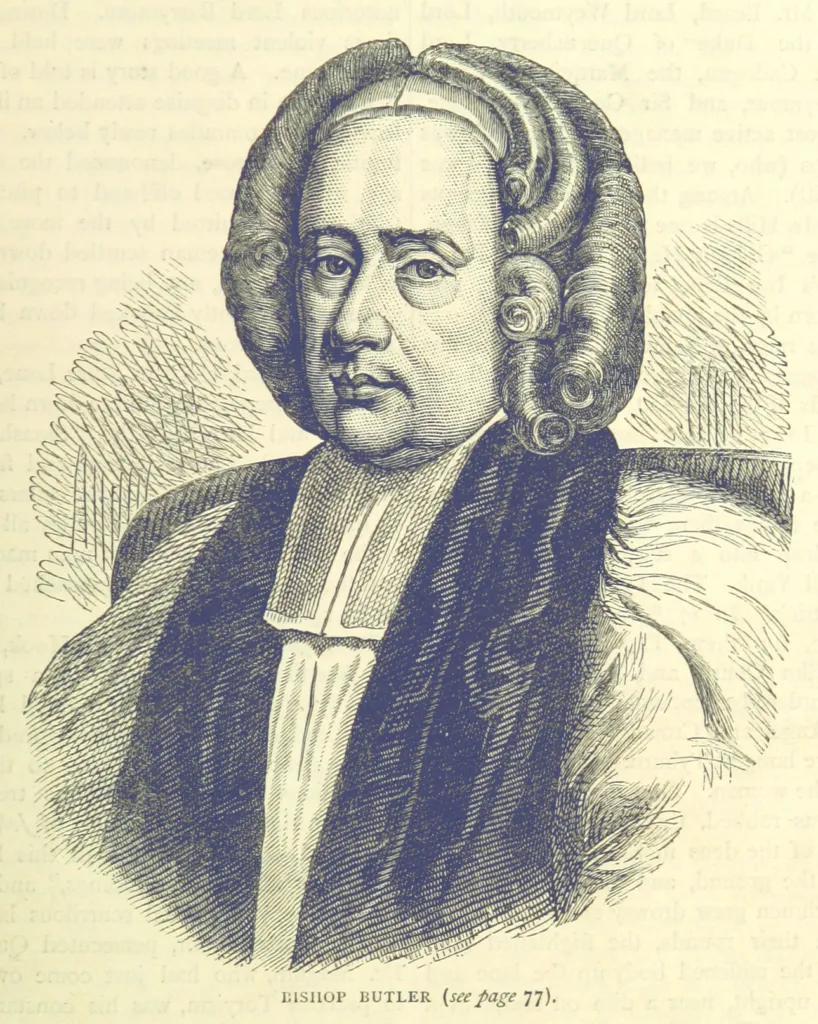
_1.073_-_Bishop_Butler.jpg)
A draper’s son from Wantage
Joseph Butler was born in Wantage on 18 May 1692, the youngest of eight children of Thomas Butler, a linen draper who had retired from trade and lived at a house called The Priory on the edge of the town. The family were Presbyterians. Joseph’s first schooling was at the town’s Latin school under the Revd Philip Barton; years later, as Dean of St Paul’s, Butler repaid the debt by giving Barton the rectory of Hutton in Essex.
Intended for the dissenting ministry, he was sent to Samuel Jones’s academy at Gloucester, which moved to Tewkesbury, where a fellow pupil was Thomas Secker, later Archbishop of Canterbury. While there he wrote to the philosopher Samuel Clarke with searching objections to Clarke’s arguments, and the exchange was later published. Butler decided to join the Church of England and went up to Oriel College, Oxford, in 1714 or 1715 (sources differ).
Preacher, philosopher and bishop
He was ordained in 1718 and became preacher at the Rolls Chapel in London. His Fifteen Sermons Preached at the Rolls Chapel (1726) set out a careful account of human nature, in which conscience has a rightful authority over self-love and the passions. Philosophers still read the sermons for their arguments on self-interest, benevolence and personal identity.
After some years as rector of Stanhope in County Durham he published The Analogy of Religion, Natural and Revealed (1736), a reply to the deists which argued that the difficulties people found in revealed religion were matched by difficulties in the natural world that deists already accepted. It was widely studied at the universities through the nineteenth century.
Butler became Bishop of Bristol in 1738, Dean of St Paul’s in 1740, Clerk of the Closet to George II in 1746 and Bishop of Durham in 1750. He died at Bath on 16 June 1752 and was buried in Bristol Cathedral. The Church of England remembers him on 16 June.
The Butler family in Wantage
The family kept its local ties. The Victoria County History records that a later Joseph Butler bought one of Wantage’s manors in 1822, and that his younger son George held it until 1826.
What to see locally
- The Priory, Wantage: the house where he was born is a private home and carries a marker recording his birth. It has at times been shown on heritage open days; check locally before visiting.
- Parish Church of St Peter and St Paul: the church of the town where he grew up.