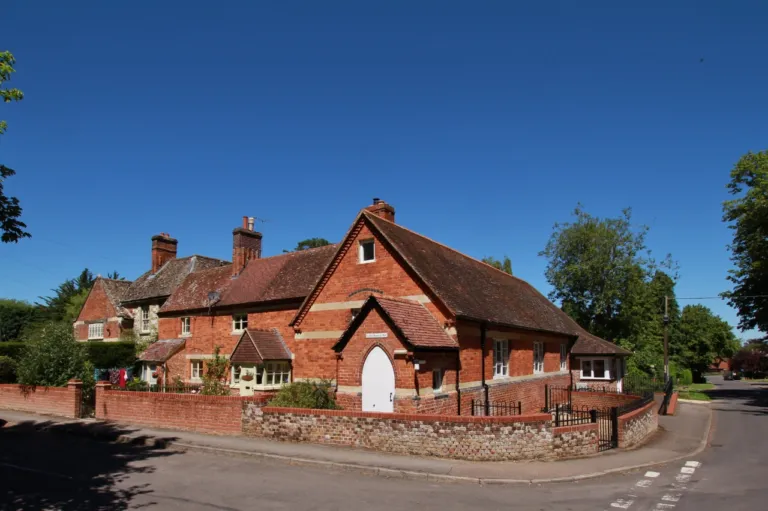
Church of the Holy Rood, Sparsholt
The Church of the Holy Rood is the Anglican village church of Sparsholt, near Wantage. The church is…
Not yet confirmed

Sparsholt is a small spring-line village at the foot of the Downs, about 3 miles west of Wantage on the B4507. It is known for the church of the Holy Rood, whose carved oak effigies are among the few of their kind in England.
Two mapped walks head up from the village to the Ridgeway and the Devil's Punchbowl, and the Griffin Hall is the village hall.
6local listings
The Church of the Holy Rood is the Anglican village church of Sparsholt, near Wantage. The church is…
Racing yard run by Grade 1-winning trainer Harry Whittington. Since April 2023 it has focused on pre-training: breaking-in,…
Peoplenetics Ltd is a firm of occupational psychologists based on West Street in Sparsholt, near Wantage. It advises…
Mobile cosmetic vehicle repairs, from alloy wheels to dents and scuffs.
Sparsholt Parish Council is the parish council for the village of Sparsholt, near Wantage in the Vale of…
The Griffin Hall is a small village hall serving Sparsholt, near Wantage in the Vale of White Horse.…
Listings are free. Add a local business, club, group or service and we will check it and put it live, usually within a day.
Sparsholt sits on the spring line where the chalk of the Berkshire Downs meets the clay of the Vale, just north of the B4507 between Wantage and Kingston Lisle. The parish is a long, narrow strip running from Sparsholt Down in the south, which reaches about 800 feet, north almost to the River Ock. Westcot, a hamlet of a few houses, lies about half a mile to the west. The parish had 308 residents at the 2021 Census.
The village grew along a single north–south street, with Sparsholt House at its southern end and the church a little to the north of it. Several cottages date from the 17th century, some timber-framed and some of brick. The village pub on Watery Lane, long known as the Star Inn, was trading as The Sparsholt at the time of writing. The village school, opened in 1874, closed in 1964; the building became the Griffin Memorial Hall in 1968. The church is part of the Ridgeway Benefice. There is no shop, and the nearest services are in Wantage.
The name first appears in an Anglo-Saxon charter of 963 as Speresholt. Place-name scholars read it as Old English for a wood where spear-shafts were cut. Domesday Book spells it Spersolt.
Before 1066 three free men held Sparsholt as three small estates. Froger the sheriff later combined them into one, and by 1086 it was royal land, assessed at 16 hides and worth just over £20 a year, with a church and 88 acres of meadow. Three smaller holdings were recorded under Henry de Ferrers, Hascoit Musard and Turstin son of Rolf. Together they made 74 households, which put Sparsholt among the larger places in the Domesday survey.
Henry I granted the manor to Robert Achard, whose family also held Aldermaston. The Achards held Sparsholt until the 17th century, and several of them are buried in the church. In 1342 Robert Achard gave the church to Queen’s College, Oxford, on condition that the college paid for masses for him and his wife. The college later settled with him for a yearly payment of 13s 4d to the poor, and this was still being paid in the 1920s. The manor was sold in 1622 to Elizabeth, Lady Craven, and passed to a branch of the Craven family. It went through several more families before the Hippisleys bought it in 1807, and they still owned it when the Victoria County History described the parish in 1924. Sparsholt House, the manor house, is mostly of 1722.
Eastmanton, north-east of the church, was a small separate manor held by the Musard family and later by the Achards. Westcot belonged to the Knights Templar, and after them to the Knights Hospitallers, who kept a grange there. After the Dissolution it passed to the Pleydell family, and in the 18th century to the Atkins family of Kingston Lisle.
The nave dates from the late 12th century. Its north doorway has two round-headed orders and beak-head label stops. The chancel and the south transept were rebuilt in the 14th century, with a fine set of sedilia and tomb recesses, and a shingled broach spire sits on the west tower. The church is best known for its three carved oak effigies of about 1300 to 1400: a knight in mail and two women, one of them probably a widow. It also has a stone effigy of a cross-legged knight, a brass of the priest William de Herleston of about 1410, and a monument to John Pleydell (died 1591) and his wife Bridget.
Sparsholt and Westcot were enclosed by an Act of 1800. The Wilts & Berks Canal, built through this part of the Vale between 1805 and 1807, crosses the north of the parish, and so does the Great Western main line of 1840, but there was never a station. By 1924 racehorses were being trained in the village, as well as the usual farming.
With the rest of the Vale, Sparsholt moved from Berkshire to Oxfordshire in the local government changes of 1974.
A downland loop from Sparsholt Firs round the rim of a dramatic chalk coombe, down to Letcombe Bassett and back up Gramp's Hill to the Ridgeway.
A one-way walk home along the Ridgeway from the White Horse, past Hackpen Hill and Segsbury Camp, then down through Letcombe Regis into Wantage.
This is a plain run-through of the villages near Wantage: which direction each one sits in, how far out it is, and…
The ancient trackway along the crest of the downs above Wantage, now a National Trail, and the lower Icknield Way along the foot of…
Sparsholt's Grade I church, with a Norman doorway, a 14th-century chancel and rare medieval oak effigies of the Achard family.
A perforated sarsen at the foot of Blowingstone Hill that booms when blown, linked in legend with King Alfred; first recorded in 1761.
Wantage and its villages have more than a thousand years of recorded history. Read it century by century, with the people and places that shaped it.
Explore local history