Christian Mobey Ltd
Crafting bespoke joinery solutions with passion, precision, and perfection since 2001.
Not yet confirmed

Kingston Lisle is a small spring-line village below Blowing Stone Hill, about 4.5 miles (7.2 km) west of Wantage. It is known for the Blowing Stone, a pierced sarsen tied by legend to King Alfred, and for the wall paintings in its Norman chapel.
Visitors come to see the Blowing Stone, a pierced sarsen linked by legend to King Alfred, and the Norman chapel with its medieval wall paintings.
11local listings
Crafting bespoke joinery solutions with passion, precision, and perfection since 2001.
Florey Marquees and Events hires marquees for weddings, parties and corporate events, with glamping tents and event equipment,…
Licensed racehorse trainer at Kingston Common Farm, a self-contained yard with an all-weather gallop, training for owners and…
Registered charity (1187447) that funds improvements to public amenities in Kingston Lisle and Fawler, such as the village…
Kingston Lisle Parish Council is the parish council for the village of Kingston Lisle, near Wantage in the…
Kingston Lisle Village Hall is a small village hall on Hill View in Kingston Lisle, near Wantage. It…
St John the Baptist is the Anglican village church of Kingston Lisle, in the Vale of White Horse…
UK-based operator arranging tailor-made safaris in Tanzania, ATOL protected.
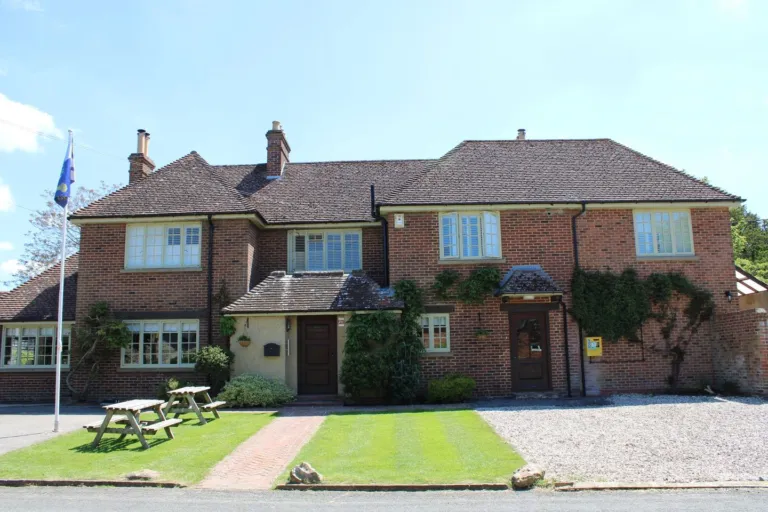
The Blowing Stone Inn in Kingston Lisle is a country pub and restaurant with letting rooms, in an…
Premium paddocks for lease in Kingston Lisle, Westcot and Sparsholt.
Listings are free. Add a local business, club, group or service and we will check it and put it live, usually within a day.
Kingston Lisle lies where springs rise at the foot of the Downs, a little north of the B4507 and below Blowing Stone Hill, the lane that climbs south to the Ridgeway. The village street runs along the west side of Kingston Lisle Park, and the small hamlet of Fawler is along a lane to the north-west. About 215 people lived in the parish at the 2021 Census. The village pub is the Blowing Stone Inn, which also has rooms. Children go to the primary school at Uffington, and the chapel of St John the Baptist belongs to the Ridgeway Benefice.
Kingston Lisle House, in the park, is a private home and is not open to the public.
Kingston means the king’s farm or estate. Here that was literally true: the land was royal demesne both under Edward the Confessor and in 1086. The second part of the name comes from the de Lisle family, lords of the manor in the 13th and 14th centuries. It appears as Kyngeston Lisle in the early 1300s.
In 1086 the king held ten hides here, recorded under Sparsholt. The land was worth £20 a year and had 200 acres of meadow and 31 households. In the mid-12th century the Crown granted it to the Fitz Gerold family, hereditary royal chamberlains, and it passed by marriage to the Lisles of Rougemont. Henry III gave the lord a Thursday market and a fair on the feast of St John the Baptist. Warin de Lisle lost his lands when he was executed in 1322 for joining the rebellion against Edward II. They were later given back to his widow Alice. In 1336 she was licensed to make a park of 300 acres of wood and land, and that park survives as Kingston Lisle Park.
Fawler, the hamlet to the north-west, was granted by King Edgar in 963 to his chamberlain. It later came to Abingdon Abbey, and it had a chapel of St James that fell out of use after the Reformation.
In 1538 Sir John Dudley sold the manor to William Hyde of Denchworth, and the Hydes later made Kingston Lisle their home. In 1749 it was sold to Abraham Atkins, and his family, later the Martin-Atkinses, held it into the 20th century. According to its listing, the central block of the house is dated 1677. The front was remodelled around 1720, wings were added around 1812, and much of the interior, including a staircase that flies across the hall, dates from about 1825. The house is Grade II*.
The Blowing Stone is a sarsen about a metre across, pierced by natural holes. Blowing into the right hole makes a deep, booming note. It stands at the foot of Blowing Stone Hill, outside a row of cottages that were once an inn. Local historians think it was brought down from the hill in the 1750s, after the Atkins family bought the estate, and it is shown in its present position on Rocque’s map of Berkshire in 1761. The story that King Alfred used it to call his troops before the Battle of Ashdown in 871 is a legend, not recorded history. Thomas Hughes described the stone and the old inn in The Scouring of the White Horse (1859).
The chapel of St John the Baptist was a chapel of ease to Sparsholt. The chancel is early 12th-century and the nave late 12th-century, with a north doorway decorated with billet moulding. The walls of the chancel have late 14th-century paintings of St Peter and St Paul, Herod’s feast with Salome dancing, and the beheading of John the Baptist. Much of the woodwork is Jacobean, including the pulpit, the chancel screen and the nave roof.
Kingston Lisle and Fawler were enclosed by an Act of 1777. The Wilts & Berks Canal was cut across the north of the parish between 1805 and 1807 and formally abandoned in 1914. The Great Western main line opened through the parish’s northern tip in 1840. The parish moved from Berkshire to Oxfordshire in 1974.
This is a plain run-through of the villages near Wantage: which direction each one sits in, how far out it is, and…
The ancient trackway along the crest of the downs above Wantage, now a National Trail, and the lower Icknield Way along the foot of…
Sparsholt's Grade I church, with a Norman doorway, a 14th-century chancel and rare medieval oak effigies of the Achard family.
A private country house of 1677, remodelled in the 18th and 19th centuries, in a park first enclosed by Alice de Lisle in 1336.
A tall chalk hunting lodge built by the Earl of Craven in the 1660s, and the small Iron Age hillfort beside it, on the…
A perforated sarsen at the foot of Blowingstone Hill that booms when blown, linked in legend with King Alfred; first recorded in 1761.
Wantage and its villages have more than a thousand years of recorded history. Read it century by century, with the people and places that shaped it.
Explore local history