
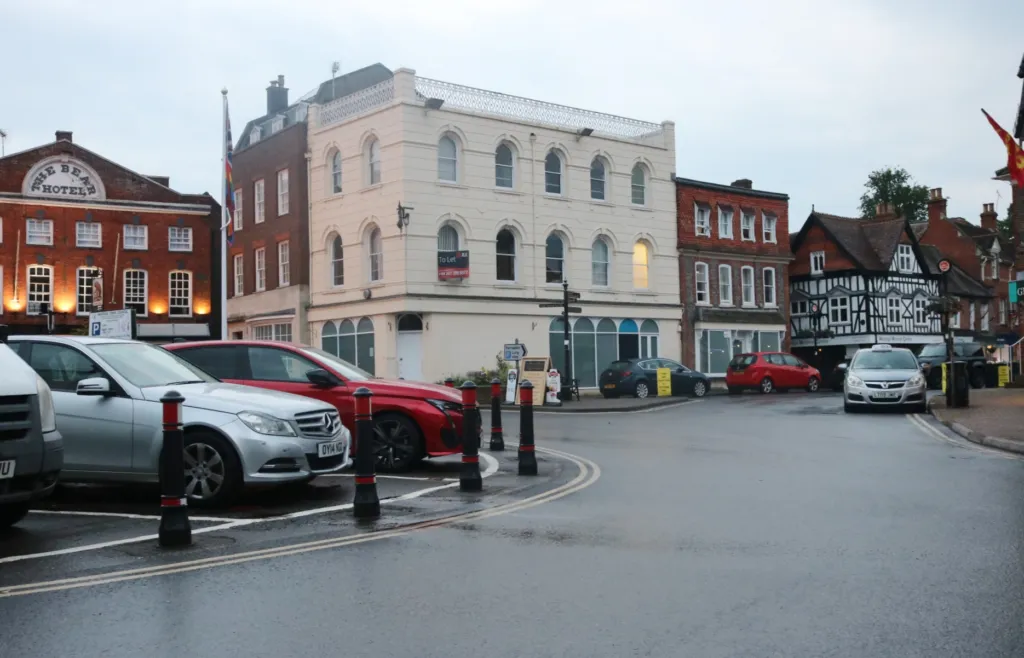

A town built around its market
Wantage grew up around its market square, and its main streets still run into it from each direction: Wallingford Street from the east, Newbury Street from the south, Grove Street from the north and Mill Street from the north-west. The town is listed among Berkshire’s boroughs and towns in 1177 and had a fair by 1213. The market place itself is first recorded in 1284, when the royal justices ordered stalls to be taken down because they had narrowed the square so much that carts could not pass; the lord, Fulk Fitzwaryn, was allowed to put them back the next year. Wantage Town Council, which runs the market today, dates its charter to 1246.
A stone market cross was built in 1580; its inscription asked prayers for the Earl of Bath, William Lord Fitzwarren and ‘Master Barnabe the builder’. It had gone from the square by the 18th century, and a fragment now stands in the Vale and Downland Museum. A town hall stood in the middle of the square until 1835; its successor was cleared in 1876 for King Alfred’s statue.
The Bear Hotel
The Bear, on the south side, is the best known of the old inns around the square. It dates from the 17th century and was refronted in brick in about 1720; the ground floor was faced in stone in the early 20th century. A trade token issued at the inn in 1653 shows it was trading by then. Inside, a first-floor room keeps 17th-century panelling and a timber-framed wall. It is listed at Grade II.
Other buildings to look for
- The Victoria Cross Gallery on the south side, built in the mid-19th century as the Corn Exchange. In about 1890 Robert Loyd-Lindsay, Lord Wantage, turned it into a gallery for paintings of Victoria Cross actions; the name is still carved over the front.
- King Alfred’s statue of 1877 in the centre of the square.
- Falcon House, a timber-framed building behind the Town Hall, and several timber-framed shops hidden behind later fronts.
Visiting
The square is open at all times. The market is held every Wednesday and Saturday, set out on either side of the statue. The Bear is a working hotel and bar. Town car parks are signed from the ring road.
Nearby
Church Street leads from the south-west corner of the square to the parish church and the museum. Mill Street, running north-west, passes the former tramway office and the site of the canal wharf.