

A gift to the town
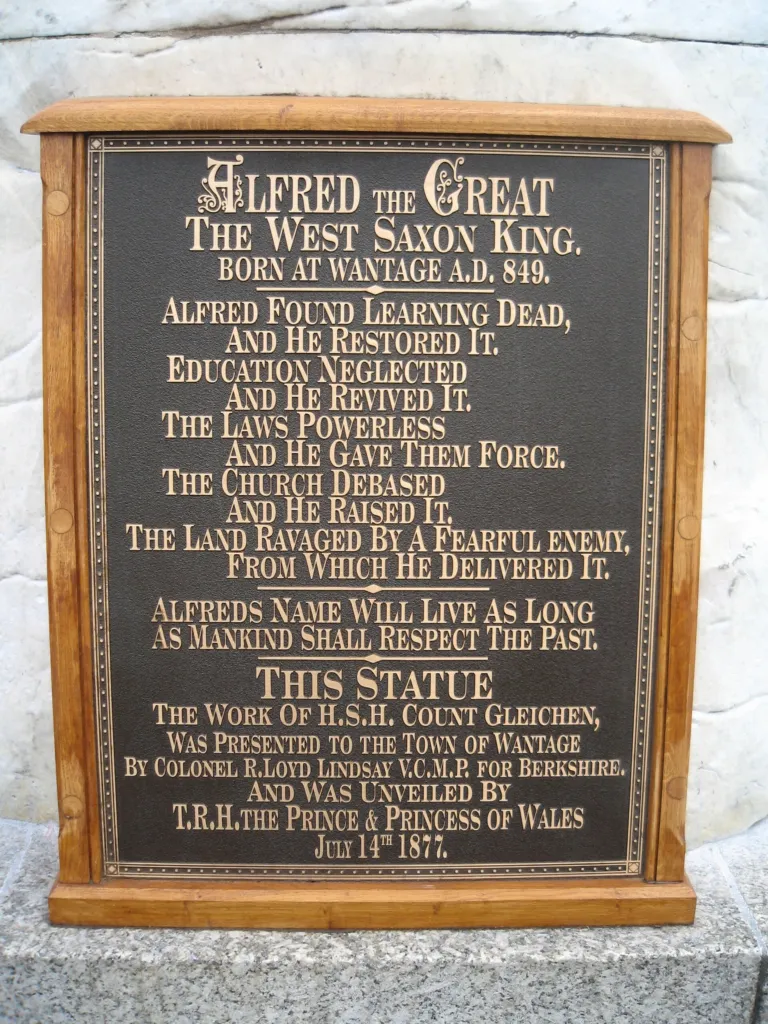
By the 1870s the Market Place still had a plain brick town hall, built in 1835, standing in its middle. Colonel Robert Loyd-Lindsay VC of Lockinge, a Crimean War hero, local landowner and MP for Berkshire, offered the town a statue of its most famous son, King Alfred, and the old town hall was demolished to make room for it. He paid for the statue, reported to have cost £2,000, and helped fund a new town hall on the corner of Grove Street.
The statue
The sculptor was Count Gleichen, Prince Victor of Hohenlohe-Langenburg, a former naval officer who had turned to sculpture and was the son of Queen Victoria’s half-sister. He showed Alfred standing, with a battle-axe in his hand, in white marble on a tall granite pedestal. Local accounts describe the marble as Sicilian and the granite as Cornish.
The ceremony
The statue was unveiled on 14 July 1877 by the Prince and Princess of Wales, later King Edward VII and Queen Alexandra. It was a major day in the life of a small market town, and the event was illustrated in the national press. The Victoria County History gives the date of the gift as 1876, the year the work was commissioned and the old town hall came down.
The statue since
Alfred has stood at the heart of the Market Place ever since, and the statue is listed Grade II by Historic England. Vandals broke off part of his right arm and his axe on New Year’s Eve 2007, and the axe was taken again a year later, on Christmas Eve 2008. Both times the damage was repaired. The statue is the town’s best-known landmark and the natural meeting point for markets, parades and celebrations.