

Alfred’s birthplace
Wantage’s written history begins with a single sentence. Asser, the Welsh monk who wrote a life of King Alfred in 893, recorded that Alfred was born at the royal estate called Wanating in Berkshire. Asser gives the year as 849, the date the town celebrates; some historians allow a range of about 847 to 849, and some local accounts give 847. Alfred was the youngest son of King Æthelwulf of Wessex and his wife Osburh, and nobody at the time expected him to become king.
Asser calls Wantage a villa regia, a royal estate. That does not mean a palace in the later sense. It was the centre of a large block of land whose farms owed the king food, labour and services, and where the king and his household could stay as they moved around the kingdom. No buildings from it have been found, and nobody knows exactly where in the town it stood.
A royal estate and its district
The importance of the estate shows in the way the area was later run. By 1086 a whole hundred, the local unit of government and justice, was named after Wantage, and its lords later held the hundred court. The church also seems to have served a wide area, with a large landholding attached to it by the time of Domesday.
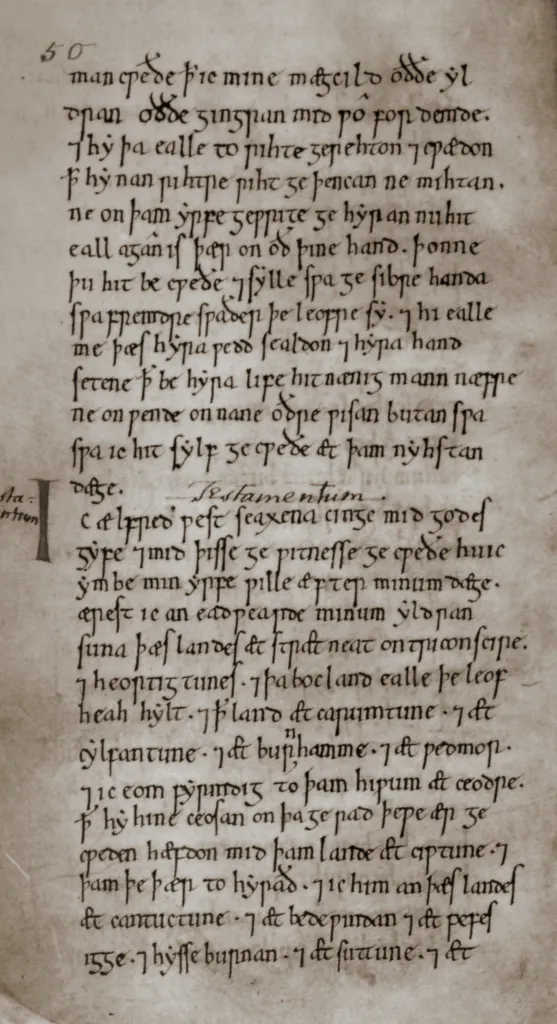
Alfred kept the estate after he became king. In his will, drawn up in the 880s, he left Wantage, with Lambourn and Edington, to his wife Ealhswith. It probably returned to the Crown after her death in 902.
The Danish wars
Alfred came to the throne in 871, a year of repeated fighting against the Danish army based at Reading. Battles were fought at Englefield, at Reading and at Ashdown somewhere on the Berkshire Downs, not far from Wantage. There is no record that Wantage itself was attacked. Alfred’s most famous campaigns, including his retreat to Athelney and his victory at Edington in 878, took place in Somerset and Wiltshire. Older claims that he ruled from Wantage, built a fort here or granted the town a charter have no basis in the sources.
How Wantage remembers him
The connection has shaped the town’s identity ever since. The thousandth anniversary of his birth in 1849 was the spur for rebuilding the grammar school, refounded in 1850 as King Alfred’s School. In 1877 a marble statue of Alfred by Count Gleichen was unveiled in the Market Place, where it still stands.