

Building the airfield
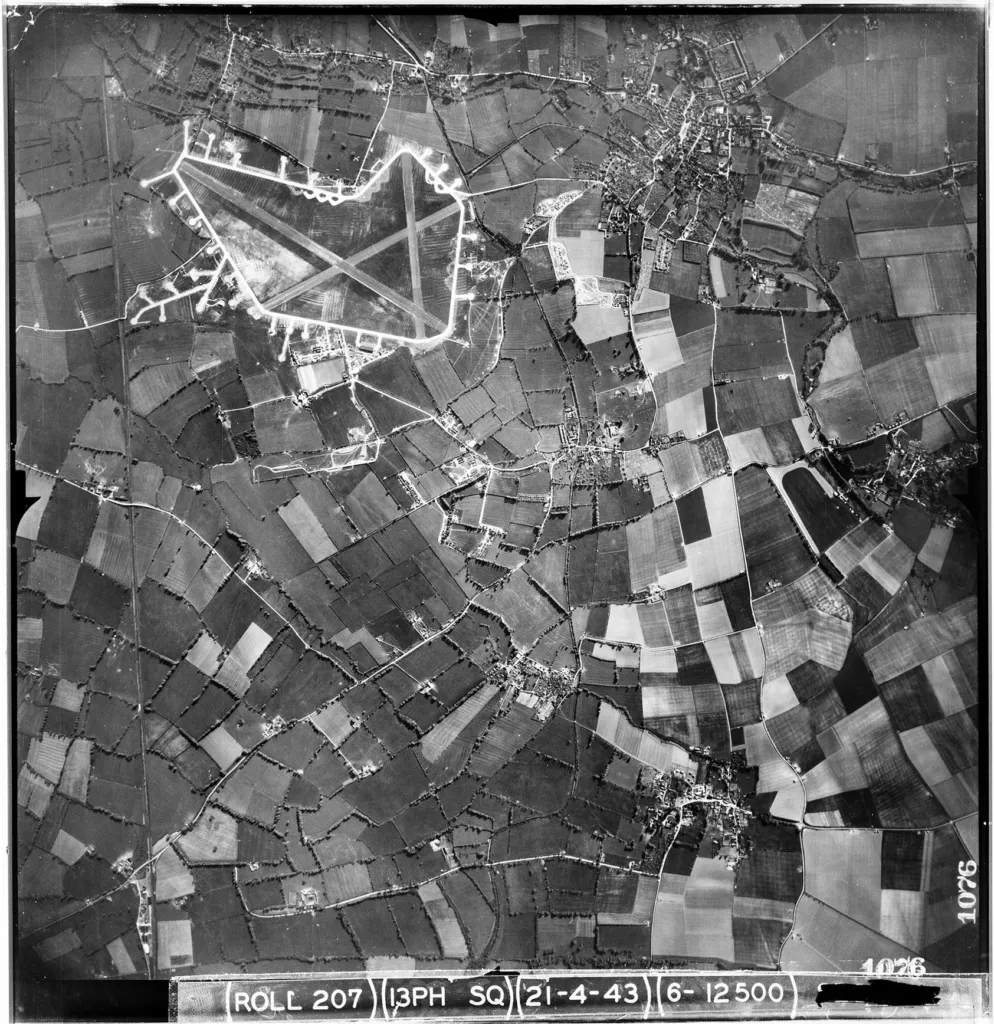
Construction of an airfield on the flat land between Grove and East Challow began in 1941. It was planned as a training base for RAF Bomber Command’s No. 91 Group, as a satellite to No. 15 Operational Training Unit at Harwell, and was usable by October 1942. Like other bomber airfields of the time it had three concrete runways, the main one about 6,000 feet long, with hardstandings and T2 hangars. In its RAF period it was used for night-flying training, and glider crews from Brize Norton trained there with Whitley tugs and Horsa gliders. Vickers Wellington bombers also flew from Grove.
The Americans at Grove
From August 1943 the airfield was handed over to the United States Ninth Air Force, which was building up for the invasion of Europe. To the Americans it was Station 519. Grove became the 3rd Tactical Air Depot of the IX Air Service Command, repairing and modifying aircraft such as the A-20 Havoc and the P-61 Black Widow night fighter, and extra hangars and workshops were added. By 1944 about 3,400 officers and men were based there.
From October 1943 the 31st Transport Group flew C-47 transports from Grove, carrying cargo and people between American airfields in Britain. After D-Day its aircraft also flew casualty evacuation and supply flights, and the group moved to France in September 1944. Units of the 27th Air Transport Group were also at Grove in 1944. Photographic reconnaissance and bomber squadrons used the airfield briefly in late 1945 before returning to the United States.
After the war
The airfield went back to the RAF in 1946 and was used for storing and disposing of surplus aircraft and equipment. From 1955 the UK Atomic Energy Authority used part of the site to support the research establishment at Harwell, and in 1957 the new Agricultural Research Council Radiobiological Laboratory began work in temporary buildings there before moving to Letcombe Regis. Research buildings, housing and industry later spread over parts of the site, and since 2017 the north-east of the old airfield has been built over as the Wellington Gate estate, whose street names recall the aircraft that flew from Grove.
What you can see
A memorial stone with a plaque to the 31st Transport Group stands beside a lay-by at Wellington Gate. Most of the rest of the airfield is private farmland or housing, though the flat open ground still shows the airfield’s scale from the surrounding lanes.