

A wedding present
Lockinge is one of a row of long, narrow parishes that run from the top of the downs down into the Vale, each with a share of chalk, greensand and clay. In the 1850s the banker Lord Overstone bought the Lockinge estate, and in 1858 it was given to his daughter Harriet and her husband, Robert Loyd-Lindsay, as a wedding present. They added the neighbouring Ardington estate in 1861, and over the next forty years made the whole area into a model estate.
Rebuilding the villages
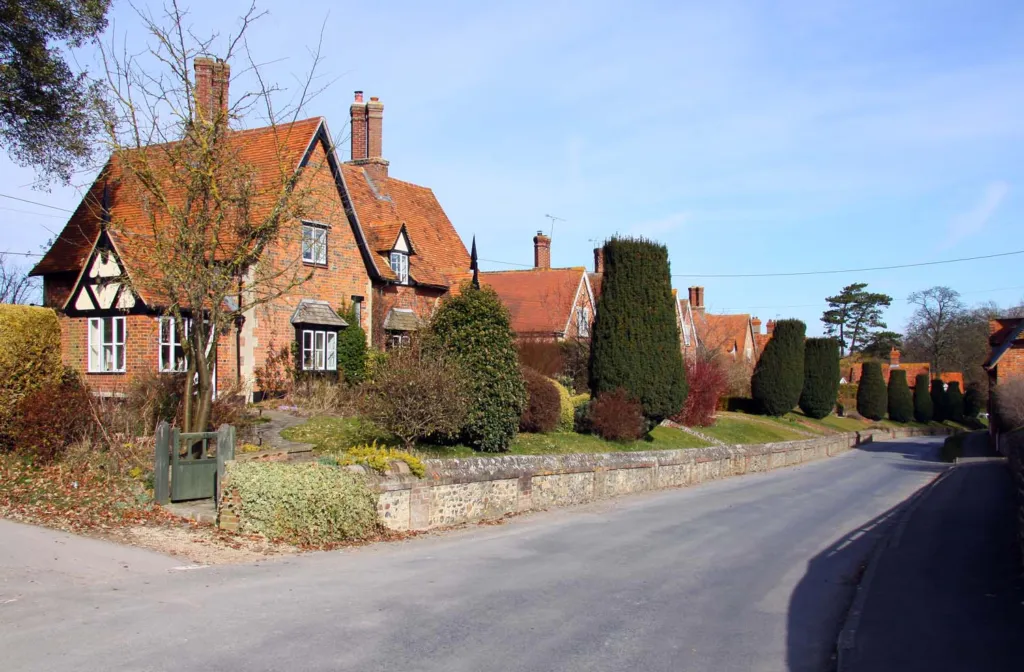
East Lockinge was largely rebuilt as a model village from 1860, and the Victoria County History, writing in the 1920s, described it as ‘well laid out and planted with trees’. Loyd-Lindsay, made Lord Wantage in 1885, put up new estate cottages across Ardington and the Lockinges and turned much of the land into a large home farm where he tried new farming methods. He paid for much of the restoration of Holy Trinity, Ardington, in 1887 and built Orpwood House in Ardington for the estate’s agent. At East Lockinge the small medieval church of All Saints, with a 12th-century nave and a tower of about 1564, was enlarged in the late 19th century so that the old church became the north aisle of a new one.
Lockinge House
The family’s home was Lockinge House, a large house built around an earlier one of about 1750 by Matthew Wymondsold, which held the Wantages’ large collection of pictures. After the Second World War the estate faced heavy death duties, and in 1947 Christopher Loyd had the house demolished. He kept the estate together, founded the Lockinge Stud, and set up trusts to provide homes for local people. The Lockinge Estate is still run by the Loyd family.
What you can see
The estate cottages, many with their characteristic gables and decorative details, still line the streets of Ardington and East Lockinge. All Saints church stands alone in Lockinge Park, with the lake formed from the Lockinge brook near by. In Ardington, the village shop, the Boar’s Head pub, the mill and the old estate workshops are grouped round the church and Ardington House.
Visiting
Both villages are on public roads off the A417 east of Wantage. Public footpaths cross the estate, and one of our walks links Ardington, East Lockinge and the Ridgeway. Lockinge Park and the estate yards are private.