
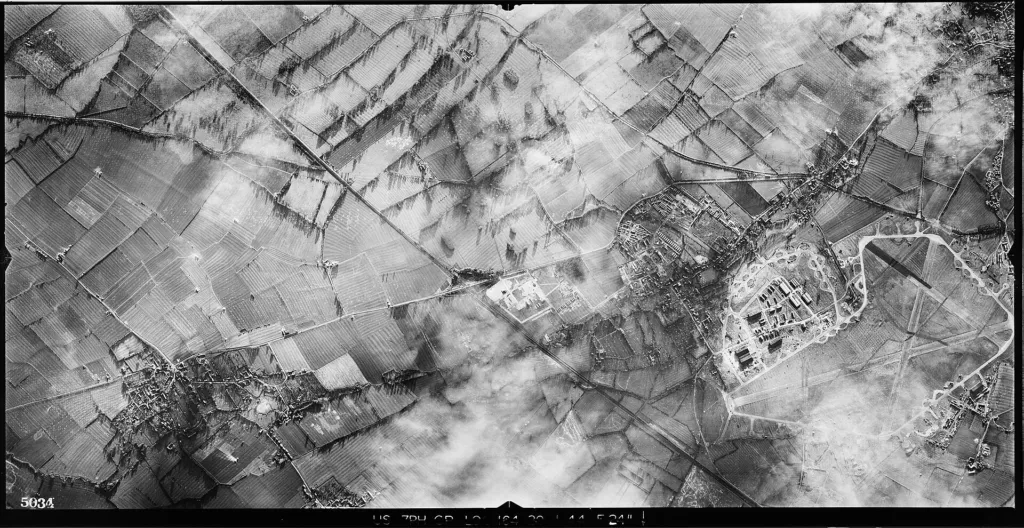

An airfield on the doorstep
The Second World War brought the biggest change Wantage had seen in generations, and it came from the fields between the town and Grove. Work on an airfield there began in May 1941, and RAF Grove was usable by October 1942. It had three concrete runways and was built as a training airfield for RAF Bomber Command, a satellite of the Operational Training Unit at Harwell, where crews learned to fly Vickers Wellingtons at night. In 1942 glider pilots trained there with Whitley tugs and Horsa gliders.
The Americans at Station 519
In 1943 the RAF moved out and the United States Army Air Forces moved in, as part of the build-up for the invasion of Europe. Known for security reasons as Station 519, Grove became a depot of the Ninth Air Force’s Air Service Command. Its 3rd Tactical Air Depot repaired aircraft such as the A-20 Havoc and the P-61 Black Widow night fighter. By 1944 more than 3,400 American personnel were based there. From 31 October 1943 the 31st Transport Group flew C-47 Skytrains from the airfield, moving cargo and people between American bases in Britain. After D-Day it was used for air ambulance and general transport work. For people in Wantage and Grove the arrival of thousands of young Americans in 1943 was a lasting memory, and it is recorded on local history trails to this day.
The home front
As in every town, the war reached into daily life through rationing, the blackout, the Home Guard and salvage drives. The iron gates given to the War Memorial Recreation Ground after the First World War were requisitioned for scrap. The Wantage Tramway, which had carried only goods since 1925, was kept busy, but its track was badly damaged by the heavy wartime lorries that shared the road beside it. It closed for good in December 1945. The detailed story of evacuees, fire-watching and air-raid precautions in Wantage has not been published; the urban district council’s records at the Royal Berkshire Archives are the place to look.
After the war
The Americans left in stages during 1945, and the airfield was handed back to the RAF in 1946. It was used first for storing and disposing of surplus aircraft and, from 1953, as an equipment depot. From 1955 the UK Atomic Energy Authority took over part of the site to support the new research establishment at Harwell. That laid the foundations for Grove’s post-war role as a place of laboratories and, much later, of housing.
Remembering
New gates for the recreation ground, given in memory of Sarah Adkin, were put up in 1948. On 8 May 1949 a stone cross of Clipsham stone, 14 feet 6 inches high, was dedicated in the churchyard of St Peter and St Paul to the men of Wantage who gave their lives in both world wars. It was unveiled by General Sir Miles Dempsey, who had commanded the British Second Army in north-west Europe. Local people and the British Legion raised the cost. The cross originally carried no names; name plaques were added to its base after it was refurbished in 2007.