

The Lisles and their park
Kingston Lisle takes the second half of its name from the de Lisle family, who held the manor in the Middle Ages. Warin de Lisle was executed in 1322 for rebelling against Edward II, and his lands were later restored to his widow, Alice. In 1336 she was granted a royal licence to enclose a park of 200 acres of wood and 100 acres of other land in Kingston Lisle, Baulking and Fawler. The park beside the village today descends from that grant. The Victoria County History notes that the lords of the manor had a house here in the 13th century.
The Hydes and the Atkinses
After passing through the Berkeley, Warwick, Grey and Dudley families, the manor came to the Hyde family in 1538. In the 17th century they left their old home at Denchworth and settled at Kingston Lisle. A datestone of 1677 over the rear door of the central block marks the house they built. From 1749 it belonged to the Atkins family, later the Martin-Atkins family.
A house built in layers
The house looks like a single Georgian building, but the national list shows it grew in stages. A new front was added to the 1677 house in about 1720. Around 1812 Edwin Martin-Atkins (1778–1825) commissioned side wings from the builders Richard Pace and Son, and in about 1825–30 the garden front was remodelled and the interior renewed. The architectural historian Marcus Binney suggested that the owner himself, rather than a known architect, was the designer.
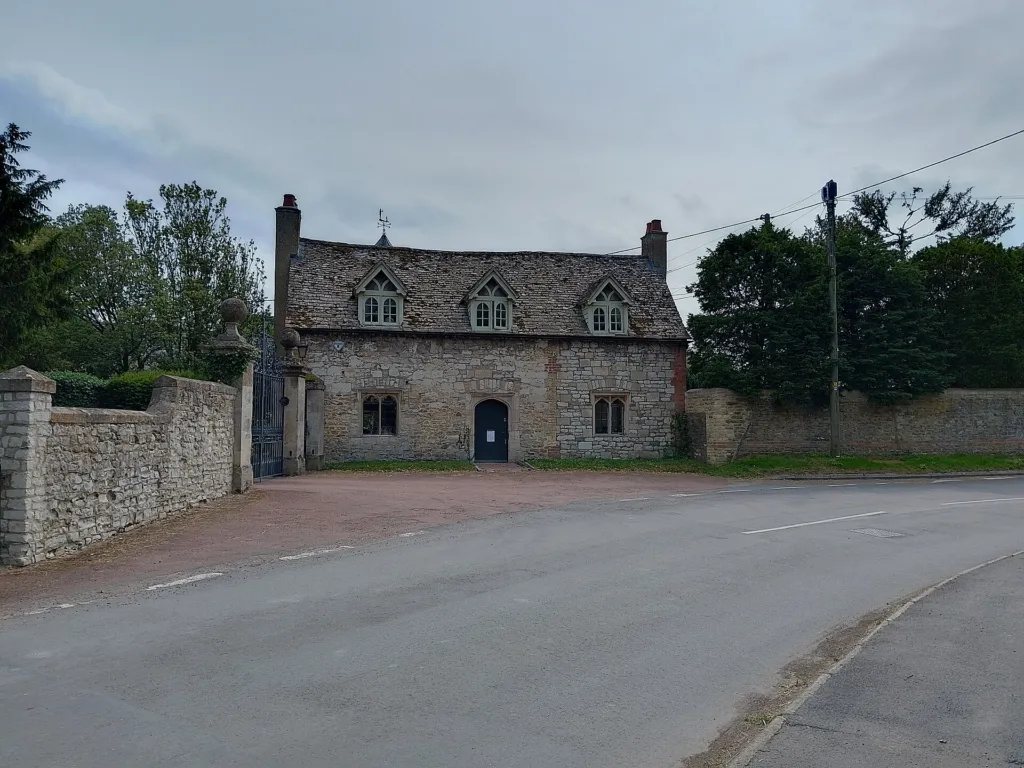
The finest thing inside is the staircase, whose two flights sweep out over the hall with no obvious means of support, with wrought-iron balusters in S-scrolls. The entrance passage is lined with fluted Doric pilasters under a coffered tunnel vault, and other rooms keep late 17th-century bolection-moulded panelling and rococo plasterwork. The lodge and stables appear to reuse Jacobean Gothic windows from an older building, and the park contains an icehouse and several sets of gates and gate piers, all listed.
Visiting
Kingston Lisle House is a private home and is not open to the public. The lodge and parts of the park can be seen from the village street. The Blowing Stone, a short walk south at the foot of Blowingstone Hill, was probably moved to its present spot by the Atkins family in the 18th century.